Britain needs a different kind of national library
Boston Spa and the national lending network

The twentieth century brought another transformation. Scientific research increasingly depended on rapidly locating and sharing publications from across the world. Researchers needed access to material that might exist only in a specialist collection hundreds of miles away.
The National Lending Library for Science and Technology developed to address this need. In 1962, it opened at Boston Spa in Yorkshire, occupying part of a former wartime munitions site. Its purpose was different from that of a grand Reading Room. Rather than expecting every researcher to travel to a collection, the service helped move information to the people who needed it.
This was a significant change in how a national information system could operate. The Library was no longer simply a destination. It could also function as a network for distributing access.
Parliament brings the services together
The developing scientific lending system existed alongside the British Museum Library, the National Central Library, the Patent Office Library and other specialised organisations. They had different collections, practices, technologies and audiences. But they shared increasingly overlapping responsibilities.
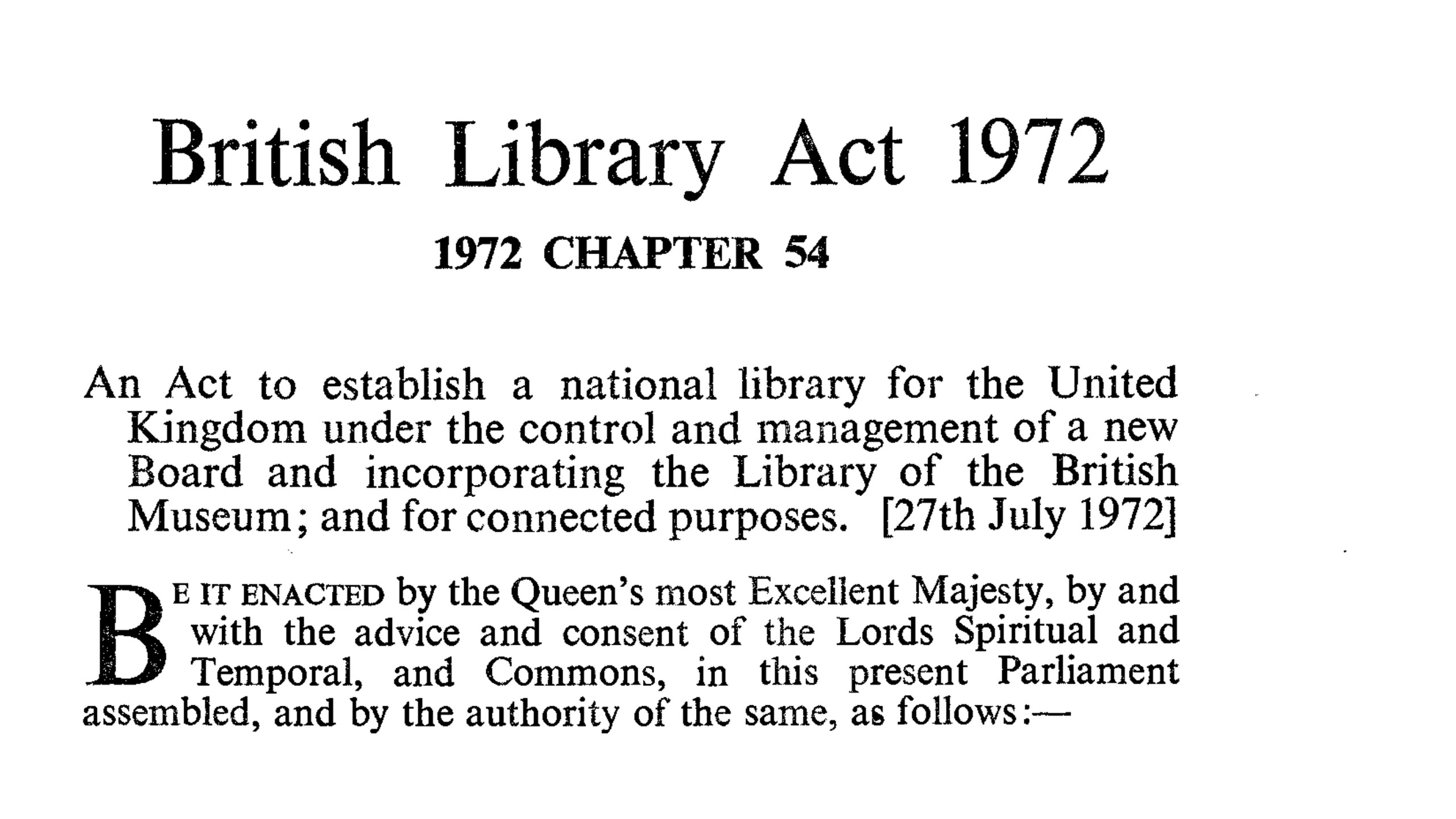
Eventually, bringing those activities together became a national policy decision. The British Library Act 1972 created the framework for a unified national library and its governing Board. On 1 July 1973, the British Library became an independent institution. This was the formal birth of the British Library as we know it.
The new organisation was meant to bring national reference, research, lending and information services into a common structure spanning science, technology and the humanities. The change created new opportunities for coordination. It also created a new problem. The Library now had to make multiple inherited institutions work together. Each had developed its own systems, specialist knowledge, staff practices, collections and ways of operating. The advantages of integration would become apparent over time. So would the risks of retaining disconnected systems beneath a common organisational identity.
Image sources — Boston Spa and the 1972 Act
Image sources and credits: ‘National Newspaper Building’ photograph: Luke McKernan (2015), resized rendition, Wikimedia Commons, CC BY-SA 2.0, https://commons.wikimedia.org/wiki/File:National_Newspaper_Building.jpg, https://creativecommons.org/licenses/by-sa/2.0/ . British Library Act 1972 scan: contains public sector information licensed under the Open Government Licence v3.0, cropped and framed, https://www.nationalarchives.gov.uk/doc/open-government-licence/version/3/ .