Chemical Equations
Where Did the Atoms Go? — Read and balance simple chemical equations.
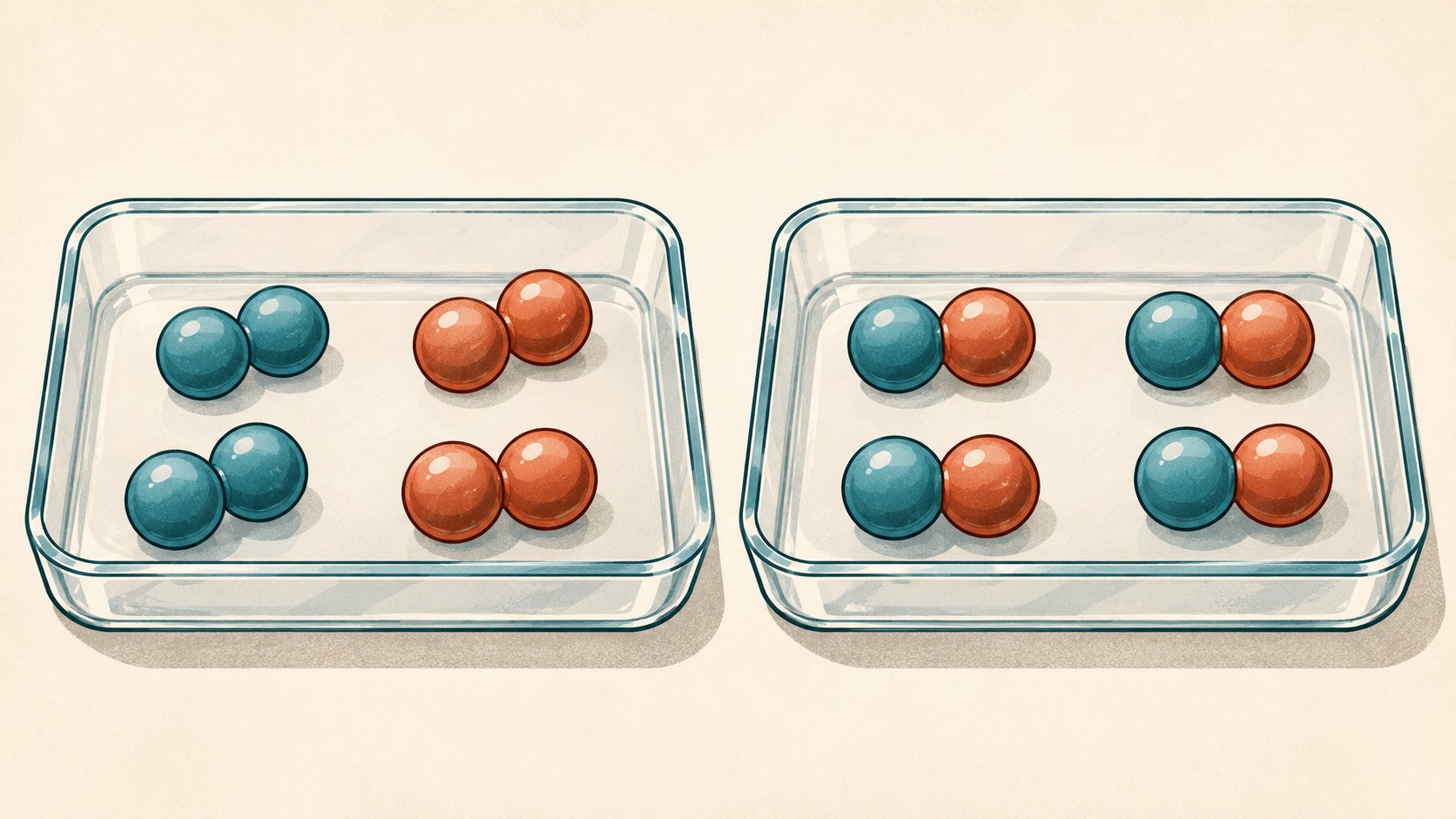
The atoms can now take new arrangements
We have followed the emergence of new nuclei, the release of some stellar matter and the possibility of forming molecules. You can now read H₂, O₂, H₂O and CO₂ as different arrangements of hydrogen, oxygen and carbon atoms.
But suppose a reaction changes one arrangement into another. What happened to the atoms that made up the first substances? Did they disappear? Were new ones suddenly invented?
Ordinary chemical reactions change which atoms are bonded to which. That can produce completely different substances, but the nuclei are not being transformed into different elements. Our next job is to keep count of the atoms while a reaction happens.
Before and after
Scientists give the starting substances a name: REACTANTS. The substances made by the reaction are PRODUCTS.
We write reactants on the LEFT, products on the RIGHT, and an arrow between them. The arrow is read as “produces” or “forms”. A plus sign between two formulas means they are both involved on that side; it is not an instruction to add their atom counts without looking at their formulas.
Here is a word equation for a familiar substance: hydrogen + oxygen → water.
Hydrogen and oxygen are the reactants. Water is the product. A word equation tells us what reacts and what forms, but it does not yet show the exact number of molecules represented.
A symbol equation says more
You already know the relevant formulas: hydrogen molecules are H₂, oxygen molecules are O₂, and water molecules are H₂O.
So we can write an initial SYMBOL EQUATION: H₂ + O₂ → H₂O.
This tells us the identities of the reactants and product. But it is not yet BALANCED. Before correcting it, we need to examine the different jobs done by small and large numbers.
Translate the story
A. Read the word equation carbon + oxygen → carbon dioxide. State the reactants and product. Using the symbols and formulas you already know, write its corresponding symbol equation. Is it balanced? Check by counting carbon and oxygen atoms on both sides.
B. Read H₂ + O₂ → H₂O. Identify the reactants and product in words. How many oxygen atoms appear on the left, and how many on the right? Explain why this arrow is not yet a completed balanced equation.
Make an attempt before choosing Check your answers. Paper answers are acceptable; opening the check is not proof that the answer was retained or submitted.
Check your answers
A. Reactants carbon and oxygen; product carbon dioxide. Symbol equation C + O₂ → CO₂. It is balanced: C one each side, O two each side. B. Hydrogen and oxygen are reactants; water is product. Left oxygen count two; right oxygen count one; the symbol equation as written is not balanced.
The number before a formula
The little ₂ in H₂O belongs to the H: one water molecule contains two hydrogen atoms. It is a SUBSCRIPT and describes that molecule.
A number in FRONT of the whole formula has a different job. It is called a COEFFICIENT. For example, 2H₂O means TWO water molecules, each containing two hydrogen atoms and one oxygen atom. So 2H₂O represents four hydrogen atoms and two oxygen atoms in all.
In 3CO₂, the leading 3 means three carbon dioxide molecules; each has one carbon atom and two oxygen atoms. Together they represent three carbon atoms and six oxygen atoms. If nothing is written in front, the coefficient is understood to be one.
Do not try to balance a reaction by changing H₂O to H₂O₂. That would rename the substance: H₂O₂ is a different formula. You may change the NUMBER of complete molecules represented, not the identity written inside each molecule.
Count without changing the formula
Complete a table with these five headings: expression | number of whole molecules | number of H atoms | number of C atoms | number of O atoms. The rows are 2H₂O, 3CO₂, 2O₂ and 4H₂.
Then answer: Why is 2H₂O not the same as H₂O₂? In 2CO₂, why is the total oxygen count four rather than two? What does a missing coefficient mean?
Check your answers
2H₂O = 2 molecules, H4, C0, O2. 3CO₂ = 3 molecules, H0, C3, O6. 2O₂ = 2 molecules, H0, C0, O4. 4H₂ = 4 molecules, H8, C0, O0. 2H₂O contains two separate water molecules, but H₂O₂ is one molecule with two oxygen atoms; the formulas describe different substances. In 2CO₂, the coefficient multiplies O₂ to give O4. Missing coefficient = one whole formula unit/molecule for these examples.
The rule we can test
During an ordinary chemical reaction in a closed system, atoms of each element are conserved. They can appear in different molecules before and after the reaction, but the number of carbon atoms must match the number of carbon atoms on the other side, and the same goes for hydrogen and oxygen.
That is why a balanced chemical equation shows an equal count of EACH kind of atom on both sides. Equal overall atom totals are not enough if the separate element counts differ.
The conservation of atoms is closely connected to conservation of total mass. When gas escapes from an open container, the mass measured only for what remains inside can change even though matter has not vanished from the wider system. We will treat the full experimental closed/open-system requirement in its own appropriate enquiry, not infer it from an equation alone.
A worked balancing investigation
Return to H₂ + O₂ → H₂O.
Count atoms on the LEFT: two hydrogen, two oxygen. On the RIGHT: two hydrogen, one oxygen. Oxygen does not match.
Put a 2 in front of the WATER to represent two water molecules: H₂ + O₂ → 2H₂O. Now the right side has four hydrogen atoms and two oxygen atoms. Oxygen matches, but hydrogen does not.
Put a 2 in front of the HYDROGEN: 2H₂ + O₂ → 2H₂O.
Check each element: hydrogen, four atoms on either side; oxygen, two atoms on either side. Now it is balanced. We did not change H₂, O₂ or H₂O; we only changed how many molecules each term represents.
These are the smallest whole-number coefficients for that reaction. They describe a ratio between amounts of molecules, not a demand that exactly four or five molecules must physically exist.
Make both sides agree
An unfamiliar symbolic reaction has been written: H₂O → H₂ + O₂. It represents the decomposition of water into hydrogen and oxygen. Such a process needs an input of energy; the written equation alone does not say the reaction happens spontaneously.
A. Count H and O on both sides before balancing. B. Place WHOLE-NUMBER coefficients in front of formulas so both sides contain equal numbers of H atoms and O atoms. C. Show your final left
ight atom totals. D. Explain why writing H₂O₂ as the reactant would be an invalid balancing move.
Make the attempt before opening Check your answers. Do not modify subscripts.
Check your answers
Initial H₂O → H₂ + O₂: left H2 O1; right H2 O2. Balanced: 2H₂O → 2H₂ + O₂. Left H4 O2; right H4 O2. Subscript change to H₂O₂ would change water to hydrogen peroxide; it is not balancing the given reaction. The balanced equation does not by itself specify conditions or provide energy.
Find the false equality
A learner writes 2C + O₂ → 2CO₂ and says it is balanced because the same letters appear on both sides.
A. How many carbon and oxygen atoms are on each side? B. Explain precisely why it is not balanced. C. Correct it by choosing either the smallest whole-number coefficients or a valid doubled set of coefficients. D. Explain why C + O₂ → CO₂ is already balanced, even though it has no written 1 coefficients.
You are not required to carry out a reaction with carbon and oxygen. This is a symbolic atom-counting task.
Check your answers
2C + O₂ → 2CO₂ gives left C2 O2, right C2 O4: oxygen fails. Smallest whole-number version C + O₂ → CO₂ (C1 O2 on both sides). Valid doubled version 2C + 2O₂ → 2CO₂ (C2 O4 both sides). Coefficient 1 is normally omitted, not an absence of atoms.
Remember this lesson
Without looking at your earlier answers:
1. Explain what a reactant, a product, a plus sign and an arrow mean in a chemical equation.
2. Count H and O in 3H₂O, and C and O in 2CO₂. Explain the difference between a coefficient and a subscript.
3. Balance H₂ + O₂ → H₂O using the smallest whole-number coefficients. Show the atom totals on both sides.
4. Explain why changing a subscript is not an acceptable way to balance a chemical equation.
5. A reaction takes place in an open vessel and a gas escapes. Explain why a lower mass reading for the contents does not by itself mean atoms have been destroyed.
6. What is the difference between an equation being balanced and a reaction being biologically or physically possible in those conditions?
Check your answers
(1) Reactants start, products form; + joins substances on a side, → indicates produces. (2) 3H₂O H6 O3; 2CO₂ C2 O4. Coefficient multiplies complete molecule/formula; subscript gives count of preceding symbol within each. (3) 2H₂ + O₂ → 2H₂O; H4 O2 both sides. (4) Changing H₂O changes its chemical identity. (5) Escaped gas is no longer in measured vessel contents but remains in surroundings; system boundary matters. (6) Balanced atom counts express a necessary accounting constraint, not evidence of a reaction mechanism, a sufficient energy supply, or an organism capable of conducting it.
The story can return to Earth
You can now read a chemical equation as an account of existing atoms being rearranged. You can count each element in the reactants and products, find the necessary coefficients and check that the atoms have been conserved.
We have not yet explained photosynthesis. That is a process performed by living organisms, not an equation that could cause itself to occur. As our history reaches the Earth and early life, we will meet the organisms and processes that turn the chemical symbols into a biological story.