Early Earth Chemistry
A World of Chemical Possibilities
Now the ingredients could meet
Our journey has reached a rocky planet. Material from earlier cosmic history helped form Earth. Gases could enter, change or escape from its atmosphere. Under suitable conditions, water could sometimes become liquid. A new kind of question is possible now: what happens when the substances come into contact?
It is tempting to jump from “water and carbon dioxide existed” to “life began”. That would skip the crucial steps. You can have molecules without a cell, and you can have a reaction without an organism. We must find out what the chemistry does before deciding what, if anything, it tells us about life.
An evidence board: three different changes
Imagine a present-day investigator using simple diagrams to study these statements. The experiment is only an analogy for the chemistry, not an observation of ancient Earth.
CARD A — Water vapour cools and becomes liquid H₂O. Each water molecule remains H₂O. This is a PHYSICAL CHANGE OF STATE.
CARD B — Some CO₂ gas enters and dissolves in liquid water. The water now contains dissolved CO₂ molecules among many H₂O molecules. Dissolving alone does not mean every CO₂ molecule has changed into another substance. This is MIXING / DISSOLUTION.
CARD C — Some of the dissolved CO₂ can REACT with water, creating a different chemical species, carbonic acid. This is a CHEMICAL CHANGE. Not all dissolved CO₂ must undergo the reaction, and the process can run in both directions.
In all three cases we can keep track of atoms. What differs is whether the molecules remain the same substance, move to another physical state or participate in a reaction that makes another substance.
Which change has actually happened?
For each case A–D, choose PHYSICAL STATE CHANGE, DISSOLVING/MIXING, or CHEMICAL REACTION. Where a case includes two different processes, name both and put them in order.
A. Water vapour condenses onto a cooler surface, leaving droplets of H₂O.
B. A small amount of CO₂ enters water; the statement says it remains present there as dissolved CO₂.
C. Some dissolved CO₂ and H₂O molecules form molecules of a newly named species, H₂CO₃.
D. Water evaporates from a rock pool that contains dissolved material, leaving a more concentrated mixture behind; no new chemical species are specified.
Then answer: (1) Which statements establish that a new chemical substance was formed? (2) Which do not establish a reaction? (3) Why would the mere presence of CO₂ and H₂O in the same place not prove that a cell had been made?
Try the distinctions on paper before opening Check your answers. You are evaluating the evidence in each statement, not guessing what might also occur elsewhere.
Check your answers
A physical change of state (water condenses); B dissolution/mixing (CO₂ stays chemically CO₂); C chemical reaction (new H₂CO₃ species); D evaporation is a physical state change and may concentrate a mixture, with no reaction established. A new substance is explicitly made only in C. A, B and D do not establish a new chemical species. Gas and water together are not evidence of the complex organisation, inherited information, metabolism or reproduction associated with living cells.
One small reaction, no vanished atoms
One example of chemical change in water is represented, in a simplified form, by: CO₂ + H₂O ⇌ H₂CO₃.
The double arrow means the reaction can proceed in both directions. Only some dissolved CO₂ is present as carbonic acid at a given time. You do not need to learn the later acid-ion reactions or calculate how much there is. The point is to see an actual NEW formula and check the atoms.
Count the left side: CO₂ has C1, O2. H₂O has H2, O1. Together that is C1, H2, O3. On the right, H₂CO₃ has C1, H2, O3. The numbers agree for every element, so the equation is balanced as written. It does not describe carbon dioxide magically turning into glucose, and it does not assert a particular ancient ocean carried out this reaction at a measured rate.
Remember your earlier lesson: a balanced equation tells you that the atoms are accounted for. It does not prove the reaction happens under all conditions, that it runs to completion or that a living system exists.
Follow the carbon dioxide
A scientist's note reads: “Carbon dioxide entered the water. Some stayed as dissolved CO₂; some could be involved in the reversible change CO₂ + H₂O ⇌ H₂CO₃.”
1. List the H, C and O atom counts on EACH side of the written equation. Is it balanced?
2. Why does the double arrow prevent the conclusion that ALL CO₂ has become H₂CO₃?
3. Is the sentence “CO₂ is present in water” by itself evidence of a new substance? Explain.
4. A pupil says: “If the equation balances, it proves that early Earth had life.” What is the missing evidence?
5. If CO₂ moves from air into water WITHOUT reacting, which chemical symbols and subscripts in its formula change?
Try the problem before choosing Check your answers. No chemistry apparatus is needed.
Check your answers
1. Left CO₂ C1 O2 and H₂O H2 O1 → total C1 H2 O3. Right H₂CO₃ C1 H2 O3; balanced. 2. The reverse direction is possible; reaction extent is condition-dependent and the equation does not assert all CO₂ converted. 3. Dissolution by itself can retain CO₂ molecular identity; a reaction requires additional evidence. 4. Even if some chemistry occurred, evidence of organised cells and biological processes is missing; balancing only establishes atom bookkeeping. 5. No element symbols or subscripts in CO₂ change simply by moving between air and water.
Places where chemistry might be different
A reaction needs suitable materials and conditions. A new molecule cannot emerge merely because its atoms are written together on paper. Earth's changing surfaces offered many possible ways to bring molecules into contact, move them, or supply energy.
In some HOT ROCK–WATER SETTINGS, water may circulate through cracks and react with minerals. Heat and differences between the water flowing out and the water around it can affect which reactions are possible. Modern hydrothermal environments help scientists build and test hypotheses about such processes. They are not proof that the first life actually began at a vent.
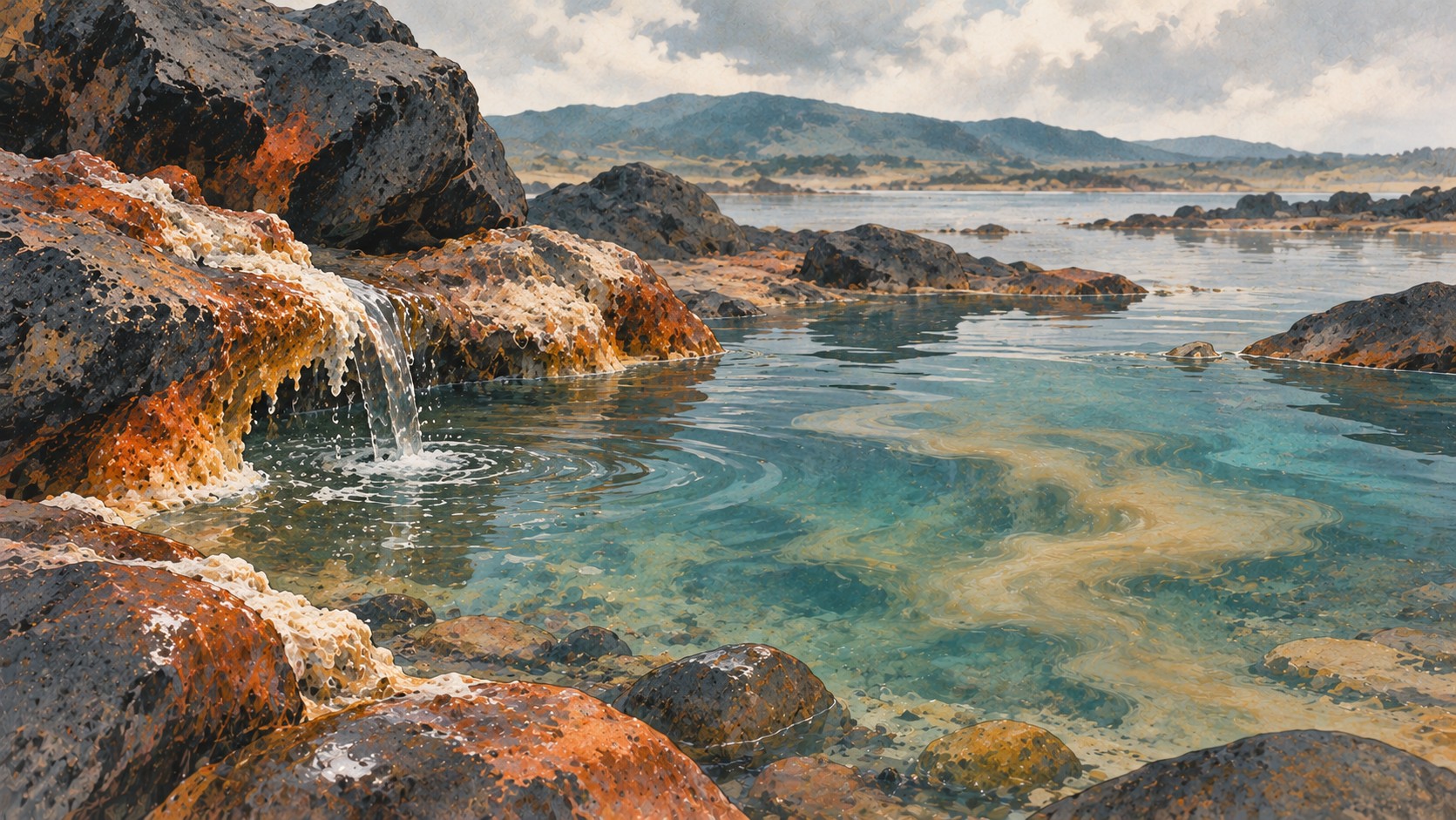
In some SHALLOW WET–DRY SETTINGS, a pool could temporarily collect dissolved substances. If some water evaporates, material remaining in solution may become more concentrated. Repeated wet and dry periods can alter how often molecules encounter one another. But a concentrated pool is still not a living cell, and scientists debate which past environments were possible and important.
Both examples are scientifically investigated possibilities, not two rival eyewitness accounts. Different energy sources, mineral surfaces and local conditions might have mattered. We are not selecting a single settled origin-of-life location in this lesson.
Choose the claim that evidence supports
Below are three descriptions of POSSIBLE environmental processes, not photographs of Hadean Earth.
SITE A — Water enters hot rocky cracks, encounters minerals and emerges warmer. The temperature and dissolved substances vary along its route.
SITE B — A shallow pool loses water during a dry period, so some remaining dissolved substances become more concentrated.
SITE C — Water exists next to a dry rock, but the description gives no particular dissolved substances, reaction conditions or usable energy source.
Questions: (1) Which site suggests energy or mineral interactions that could affect chemical reactions, and which physical features are relevant? (2) Which site most clearly concentrates a pre-existing mixture and by what physical process? (3) What further evidence would you need before claiming ANY site produced a living cell? (4) Why can the descriptions alone not identify the actual birthplace of life?
Check your answers
1. Site A: hot rock-water contact, minerals, flowing fluids and temperature differences may influence reactions. 2. Site B: loss of water by evaporation can concentrate remaining dissolved material. 3. Direct or indirect evidence of genuinely living organisation and relevant chemistry, not merely water and minerals; identify surviving materials/physical models or experimental tests. 4. No direct observation of the first life, incomplete early rock record, different plausible conditions and hypotheses; matching a scenario does not demonstrate historical uniqueness. Site C alone supplies insufficient process detail and does not justify concluding life developed there.
Remember: the line between chemistry and life
Close the earlier Sections before answering.
1. Explain the difference between water vapour condensing, CO₂ dissolving in water, and dissolved CO₂ reacting with H₂O.
2. In the reversible equation CO₂ + H₂O ⇌ H₂CO₃, count every element on both sides and explain what the double arrow tells us.
3. A learner combines H₂O and CO₂ in a diagram and labels the result “a photosynthesising cell”. What is wrong with that inference?
4. Give one condition that could make a hot rock-water system chemically interesting, and one way a shallow pool might change the concentration of a mixture.
5. What can a balanced equation establish? Name one thing it cannot establish.
6. Why must the history of living systems be investigated separately from the mere availability of water and carbon-containing molecules?
Check your answers
(1) Condensation: H₂O vapour→liquid H₂O; dissolution: CO₂ gas→dissolved CO₂; reaction: some CO₂ and H₂O form different H₂CO₃. (2) C1 H2 O3 both sides; reversible double arrow means both directions are possible under suitable conditions, not that all reactants have reacted. (3) Two substances touching/mixing do not constitute a cell or photosynthesis; specialised biological organisation, energy flow and mechanisms are unproven. (4) Heat/mineral surfaces/chemical or thermal differences in site A; evaporation raises concentrations in site B. (5) Balancing accounts for atoms, not rate, likelihood, energy availability or life. (6) Life requires structures and ongoing processes not established by simply listing chemical ingredients; origin and timing remain under scientific investigation.
Leaving the Hadean behind
This Earth had matter that could be brought together, dissolved, concentrated, separated and sometimes rearranged by chemical reactions. Its surface and environment were not fixed. Nothing in those facts proves the appearance of a living cell, and none tells us that photosynthesis already existed.
Now our chronological thread moves onwards to the Archean Eon and the emergence of life. The next question is not merely which molecules the planet could contain, but what makes matter part of a living system that can maintain itself, use energy and reproduce. The answer will need more than an equation.
GCSE knowledge coverage
Key knowledge: Condensation changes a physical state without changing the H₂O molecular formula. Dissolved CO₂ can remain chemically CO₂; some can reversibly react with H₂O to form a different species, H₂CO₃. The written equation conserves H, C and O atoms, while physical and chemical conditions determine which processes may occur. Early Earth settings such as rock-water systems and temporary pools are evidence-informed hypotheses, not a demonstrated origin of life.
This lesson applies earlier work on molecular formulae, physical states, chemical equations and conservation. It introduces an Earth-history example without assessing advanced acid-base chemistry, equilibrium or a further complete GCSE topic.