Living Chemistry
The Chemistry That Keeps Going — What makes chemical reactions part of a living system?
When the evidence changes
You have followed a world that could contain molecules, dissolved substances and chemical reactions. None of that was proof of life. But the surviving Archean record does contain evidence that living organisms were present during part of that immense eon. The record is incomplete, and some of its oldest possible biological traces are disputed. We cannot use a single rock to identify the exact first living cell.
The earlier Archean and Life lessons have already explained how geologists investigate ancient traces and why a living system is more than a flame, crystal or isolated reaction. We will not invent a detailed origin story here. We will ask what chemistry does in a system we can recognise as alive.
A cell is not one equation
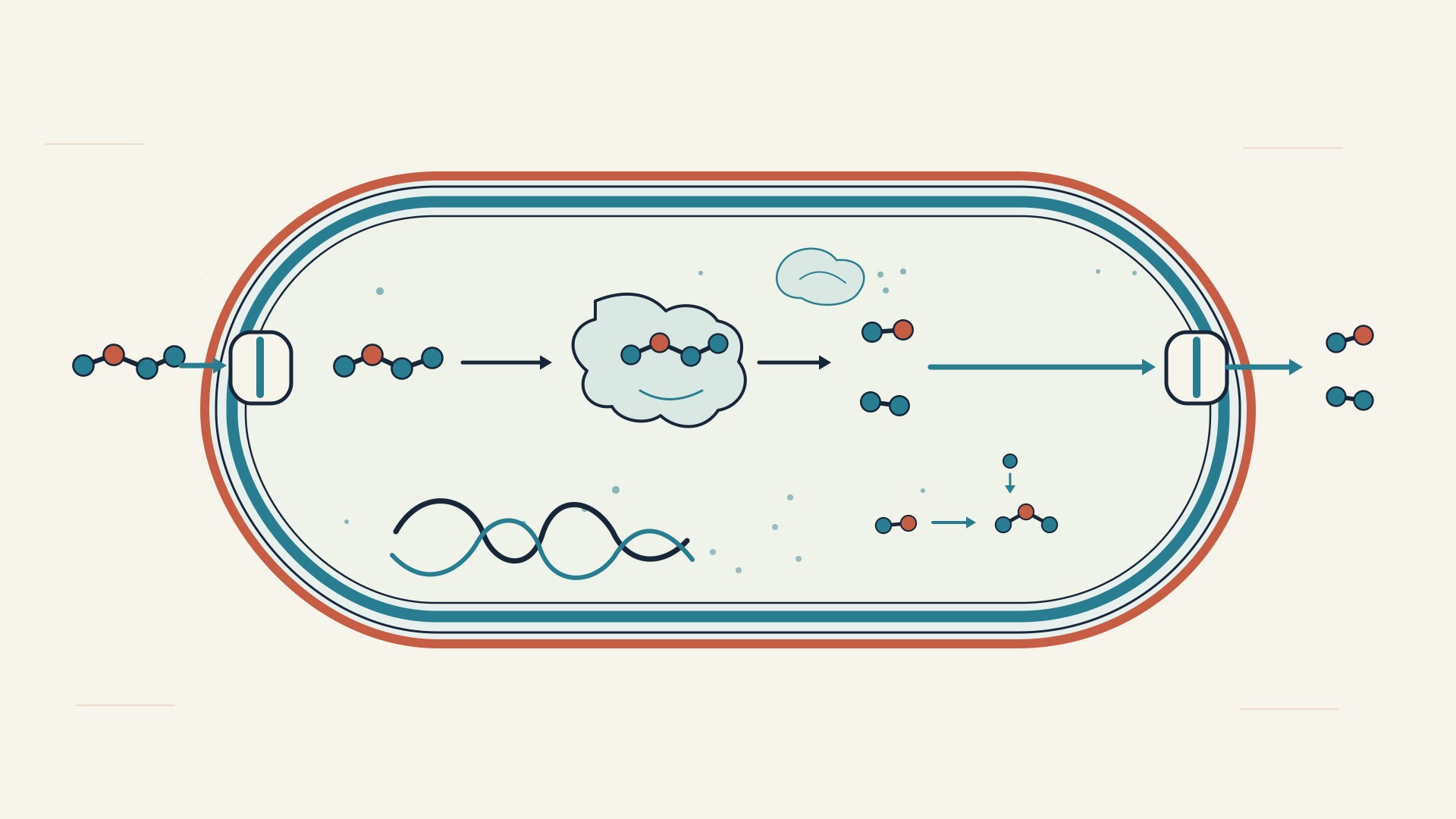
A cell is an organised living system. Inside it, many chemical reactions happen, not one single reaction repeated in isolation. These reactions can form connected sequences. A substance made during one change can become an ingredient for another.
The total set of chemical reactions taking place in a living organism is called its METABOLISM. A cell must obtain materials and sources of energy from its surroundings, even though the particular source and pathways differ greatly between organisms.
For now, imagine the chemistry inside a cell as a network with connections between stages. It does not create atoms from nothing. It rearranges existing matter while transferring energy and producing substances the cell may use, retain, transform or release.
A cell chemistry ledger
Here is a simplified, invented model based on general cell principles. Its letters A, B and C stand for materials, not specific ancient molecules. This is NOT a claimed pathway from the first cell.
ENTRY: A cell takes in material A and has access to an energy source. PROCESS 1: a reaction changes A into material B. PROCESS 2: B is used with another available ingredient to produce C. USE: some C is incorporated into cell material or used in another reaction. OUTPUT: other materials may be released into the surroundings.
One reaction supplies a material that another uses. The cell must continue obtaining inputs, maintaining conditions and dealing with outputs. If the necessary materials or energy stop arriving, its chemistry may not be able to continue.
The ledger is useful because it makes you follow a connection rather than just memorise a definition. Real living chemistry contains many more steps and controls. The arrows are about processes, not proof that every cell uses this exact sequence.
What happens next?
Read the four ledger cards and answer WITHOUT inventing a specific ancient organism: 1. A enters a cell. 2. Process 1 produces B from A. 3. Process 2 uses B to make C. 4. Some C becomes part of the cell; other material leaves.
A. Which material connects Process 1 to Process 2? B. Which card demonstrates that a product can become another reaction's input? C. If Process 1 stops making B, what might happen to Process 2, assuming no other source of B? D. Does the ledger prove the first Archean cell had Processes 1 and 2? Explain. E. The cell receives energy from its surroundings. Is that new energy being made from nothing?
Try this on paper before opening Check your answers. The questions examine links in the model; no permanent Person response or automatic mastery credit is implied.
Check your answers
(A) B connects Process 1 to Process 2. (B) Card 3 explicitly says B, the product of Process 1, is used in Process 2. (C) Without B and with no alternative, Process 2 lacks one input and may stop or change. (D) No. The ledger is an illustrative general model, not a fossil record or an identified ancient pathway. (E) No. Energy is transferred from the source; it is not created from nothing.
Building, breaking, transferring
Some cell reactions BUILD larger or more complex molecules from available materials. Those processes require suitable ingredients and, often, an energy input. Other reactions BREAK molecules down or transform them into different substances. Some of these transformations can make energy available for the cell to use in other processes.
Cells can connect reactions that release usable energy to other processes that require it. Energy is TRANSFERRED and eventually dispersed; it is not manufactured by a balanced formula. Matter is also continually taken in, transformed and exchanged, while atoms remain accounted for in ordinary chemical reactions.
Living things differ in how they get energy. Some use sunlight. Others use energy from chemical reactions involving substances in their environments or food they consume. Some microorganisms do not need free oxygen gas for their energy-producing pathways. Therefore, neither oxygen-rich air nor photosynthesis was a universal requirement for the earliest living systems.
Sort the chemistry claims
Sort each statement as SUPPORTED, NOT SUPPORTED or NEEDS MORE EVIDENCE. Give a reason.
1. If a cell builds a carbon-containing molecule, the carbon atoms had to come from existing material.
2. Because a cell uses energy, it creates energy out of nothing.
3. Every living cell must use light to obtain energy.
4. A sequence of reactions can use the product of one reaction in a later one.
5. If some microbes survive in environments with very little free O₂, all such microbes must be carrying out photosynthesis.
6. An unobserved Archean cell used precisely the same hypothetical A → B → C pathway as our card model.
Check your answers
1 supported: carbon atoms are existing matter, not invented by metabolism. 2 not supported: energy is transferred, not created. 3 not supported: chemical energy sources exist and not all cells photosynthesise. 4 supported: a pathway can reuse intermediates. 5 not supported: oxygen-independent metabolism does not imply photosynthesis. 6 needs more evidence
ot established: an invented diagram cannot identify a particular vanished early pathway.
What kinds of molecules does life use?
Living systems are made from ordinary elements, but they arrange carbon-containing molecules in many ways. Different molecules can form structures, take part in reactions, hold or carry information, or become material from which other molecules are made.
Among familiar modern biological molecules are PROTEINS, which perform many jobs including catalysing reactions; LIPIDS, many of which help form cell boundaries; and NUCLEIC ACIDS, such as DNA and RNA, which help store or transmit biological information. These are brief signposts, not compulsory new lessons on their structures in this selected thread.
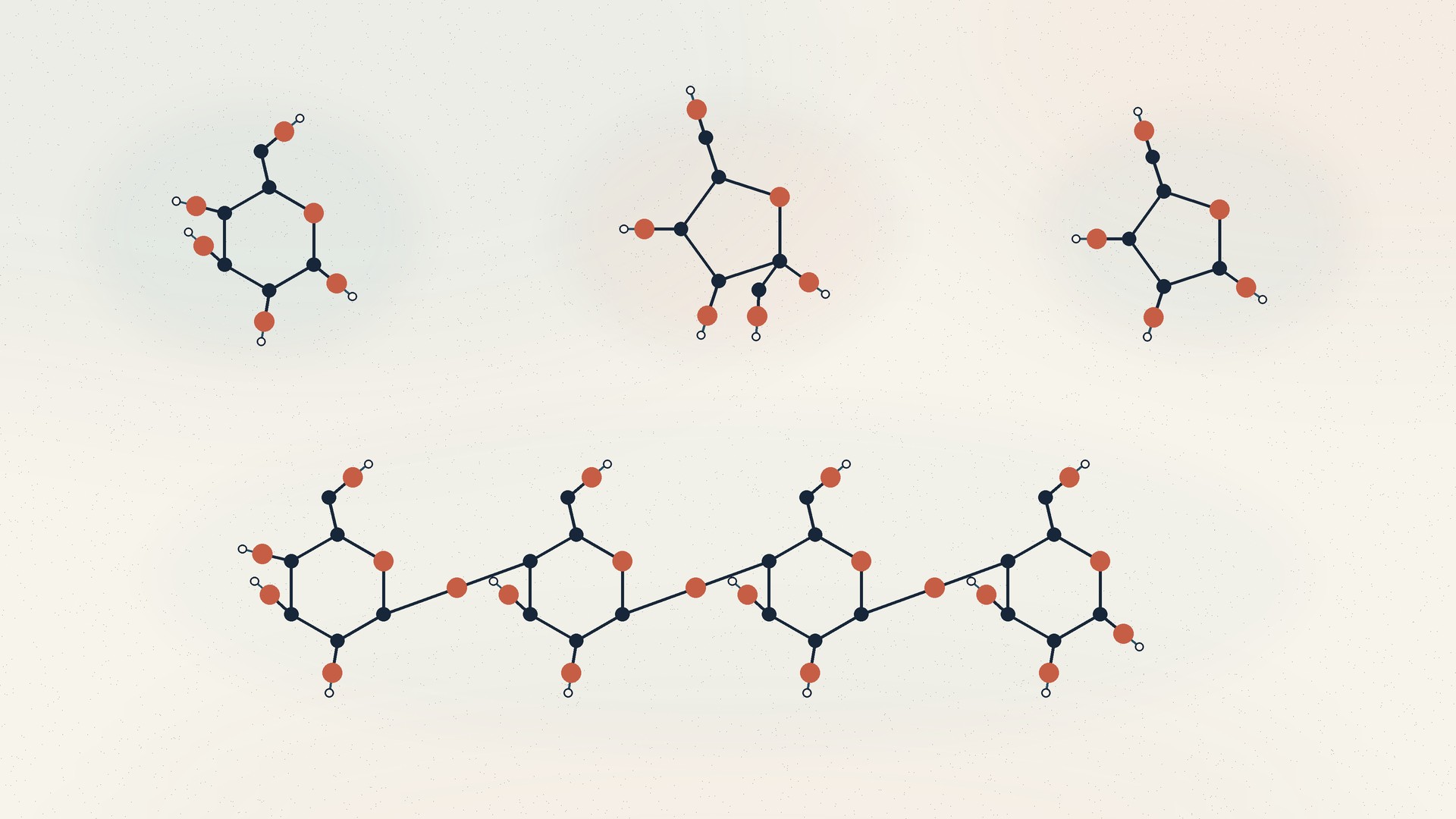
Our immediate branch follows CARBOHYDRATES, then SUGARS, then one particular sugar called GLUCOSE. They will help us connect a molecule's chemical composition to what organisms can build, store and use. Not every organism makes glucose from light, and the first organisms did not necessarily use modern glucose chemistry in exactly the same way.
An important distinction: the symbols in a chemical formula tell us the element counts in a molecule. They do not by themselves tell us everything about its shape, reactions or biological job. That requires additional evidence and knowledge of the particular substance.
Matter, energy and claims about life
Consider three carefully described situations:
A. A mineral surface causes a reaction in a rocky pool, but the description provides no evidence of a cell or of an ongoing self-maintaining biological system.
B. A present-day microorganism takes in materials and obtains usable energy through chemical reactions, maintaining and reproducing itself without needing light.
C. A modern photosynthetic organism uses light energy in a network of reactions that helps build sugar from simpler molecules.
Questions: (1) Which description gives evidence for a living organism? (2) Which of the living examples uses light? (3) Which example shows that energy use in life does not automatically mean photosynthesis? (4) What would you need to investigate before calling the mineral-surface reaction a living system? (5) Which of these descriptions permits the conclusion that the FIRST life already photosynthesised?
Check your answers
(1) B and C are expressly living microorganisms/organisms; A alone lacks evidence of life. (2) C uses light. (3) B is living but no light requirement. (4) Evidence of organised living processes, sustained maintenance, heredity
eproduction where applicable, or other strong biological signatures—not just one catalysed reaction. (5) None: living examples today and a nonliving pool do not date the emergence of photosynthesis or prove it was the first life’s energy strategy.
Remember the difference
Close the lesson and answer these questions independently.
1. What is metabolism, and why is it more useful to imagine a network of reactions than just one equation?
2. How can a product from one cell reaction become a reactant in another? Give a simple A, B, C example.
3. What do cells need from their surroundings to sustain chemical activity, and why is that different from inventing atoms or energy?
4. Describe one building process and one breakdown or transformation process in general terms, without claiming that either was the first metabolic pathway.
5. Why do the words ‘life’ and ‘photosynthesis’ not mean the same thing?
6. Why do we need the next Carbohydrates → Sugars → Glucose Pages, rather than treating the symbol sequence C₆H₁₂O₆ as a complete explanation of glucose?
Check your answers
(1) Metabolism is the set of chemical reactions in living systems; connected products and inputs form networks/pathways. (2) A → B, B plus available material → C; B is intermediate, no newly created atoms. (3) Materials plus energy sources, exchanged with environment; conservation holds for atom identity and energy accounting. (4) A building process assembles larger cell material, often requiring energy; another breaks down/transforms substances, sometimes making energy available for cell work; specific ancient reactions unknown. (5) Photosynthesis is a particular way some organisms obtain and transform light energy to build organic matter; living systems use varied strategies. (6) A formula gives elemental composition, but the identity of glucose as a particular sugar and what organisms use or make it for need later chemical and biological teaching.
The next question is a molecule with a job
You now have the crucial distinction. Atoms and molecules can take part in countless reactions outside living systems. Inside cells, networks of reactions are organised to keep the system operating, exchange materials, make new substances and handle energy.
Now we will follow just one useful family of carbon-containing substances, rather than catalogue every type of biological molecule. A simple sugar can help a cell obtain materials and usable energy, or become a building block for other molecules. How does that work, and which sugar matters to the photosynthesis equation you are working towards?
Follow the original source hierarchy into Carbohydrates, then Sugars, then the existing Glucose identity. The equation itself is still ahead, not to be memorised here.
Deeper page
Carbohydrates
Continue into Carbohydrates to distinguish the useful family that includes sugars, starch and cellulose.
GCSE knowledge coverage
Key knowledge: metabolism comprises the coordinated chemical reactions in a living system. Cell reactions transform materials and transfer energy. Reaction products can feed subsequent reactions; some cell pathways construct complex molecules and others break down or transform them. Living cells use varied sources of energy, so metabolism does not necessarily imply photosynthesis or a need for abundant free O₂. Carbohydrates/sugars/glucose are selected as the next chemistry branch.
Coverage and qualification discipline: selective introductory LIFE-CHEMISTRY CONNECTION under the original Journey Map, not completion of an entire GCSE biology/chemistry metabolism unit. Reuses Life’s organism-defining criteria and Prokaryotic Cells’ membrane/cytoplasm explanations, and reuses chemical notation/balancing from earlier Pages. Does not award invented Pearson specification ticks for ATP chemistry, enzymes, glycolysis, respiration or photosynthesis that were not separately taught and checked.