Glucose
The Sugar Behind the Formula
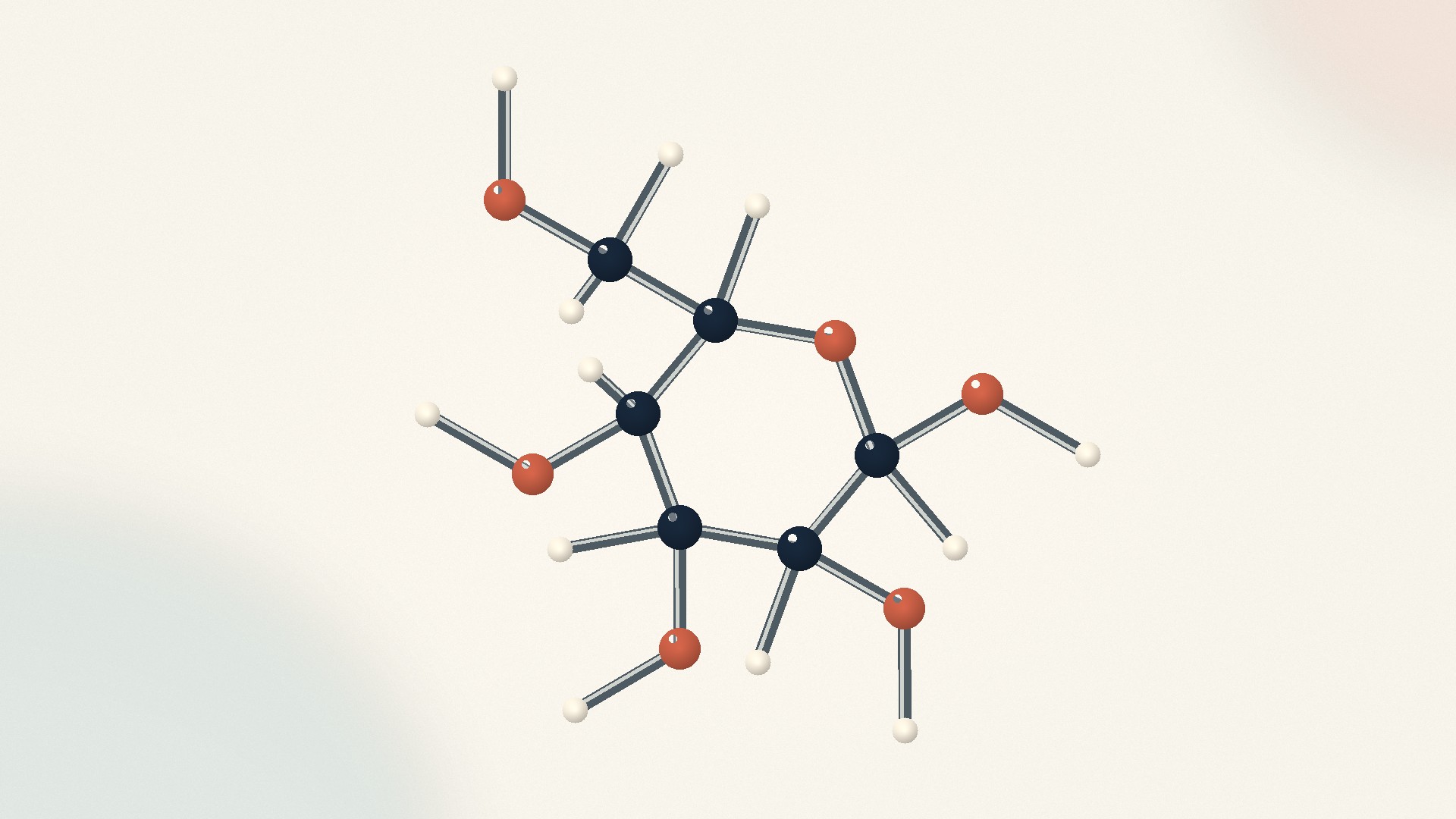
A familiar set of symbols
You have already met C₆H₁₂O₆ in the Sugars Page. Its subscripts tell you that one molecule contains six carbon, twelve hydrogen and six oxygen atoms. Now we can use that knowledge to ask a different question.
You also know that a molecular formula alone cannot identify glucose rather than fructose. Here the substance has been identified as GLUCOSE. The new question is what might happen to its atoms when a living cell uses it.
Glucose is a particular monosaccharide. In a cell it may enter different sequences of reactions or provide material that becomes part of other substances. The name is a starting identity, not a prediction of one inevitable outcome.
Follow the atoms
A casefile states: Two molecules independently identified as glucose enter a cell. Each has the formula C₆H₁₂O₆. Later, some carbon originally carried by the glucose is detected in other cell material.
1. How many carbon, hydrogen and oxygen atoms were present in the TWO incoming glucose molecules altogether? 2. Could a new molecule receive seven carbon atoms from only ONE of those glucose molecules if no other carbon source contributed? Explain. 3. Does finding some labelled carbon in new cell material prove that all the glucose was stored or respired? What additional evidence would be needed? 4. What changes, and what does not, when the notation becomes 2C₆H₁₂O₆?
Check your answers
Two glucose molecules contain C12 H24 O12 in total. One glucose molecule supplies at most six of its own carbon atoms; seven cannot come from that single molecule without an additional carbon source. Detecting its carbon in another compound traces some matter but does not identify all destinations or the complete pathway; further tracing, product measurements and reaction evidence would be needed. The coefficient 2 indicates two molecules with twice the overall atom count; it does not change glucose's identified chemical structure.
One molecule, several possible paths
A cell does more than recognise the name of a molecule. Reactions can transform glucose, and the resulting atoms may become part of other compounds. Different conditions and pathways can lead to different destinations. Counting glucose's atoms does not tell us in advance which path a particular cell took.
What cells do with glucose
A cell can take glucose into a sequence of chemical reactions. Through processes such as cellular respiration, chemical changes involving glucose transfer energy that the cell can use for other work. Glucose is MATTER; it is not itself a free-floating packet of energy, and a cell does not create energy from nothing.
The carbon atoms in glucose can also become part of other molecules as cells build and transform their materials. Different organisms do this in different ways. The broad lesson is that the same starting molecule can have different chemical destinations.
Photosynthetic organisms such as plants can form glucose from simpler substances using light energy. We will meet those mechanisms in the existing Photosynthesis lesson. We are naming a familiar modern biological route, not asserting that the earliest life already photosynthesised.
Follow matter and energy separately
A living-cell investigation records three observations: A. Carbon originally present in glucose appears later in another cell molecule. B. Chemical changes involving glucose transfer energy that the cell can use for work. C. A plant incorporates some glucose-derived material into starch.
1. Which observations trace matter, and which concern energy transfer? 2. Do A and B identify one exact sequence of reactions, or could different pathways produce such observations? 3. Does C mean atoms have disappeared when a larger carbohydrate forms? 4. Correct these claims: 'Breaking a chemical bond always releases energy' and 'Balancing a formula proves that a cell can make glucose under any conditions.'
Check your answers
A and C trace material redistribution; B specifically reports energy transferred through cellular chemistry (the reactions also rearrange matter). A and B do not identify one unique pathway without further evidence. Formation of starch rearranges and links existing atoms; it does not erase matter. Bond breaking requires energy input, and the net energy balance depends on the overall reactions, including bonds formed. A balanced equation establishes atom counts, not that a process occurs without suitable conditions, pathway and energy source.
One destination, not the whole story
You have already met starch as a larger carbohydrate used by plants for storage. Glucose-derived units can become part of starch, but that is only one possible destination for glucose material.
The existing Photosynthesis lesson will explain the relevant production, storage and experimental evidence in detail. We do not need to repeat its starch demonstration or full reaction here.
There is one more vital boundary. Having the glucose formula and a list of modern plant uses does not tell us when glucose first existed in life or which molecules the earliest cells used. We must follow the original chronological teaching through Early Microbial Life and Prokaryotic Cells before reaching the existing Photosynthesis destination.
Remember and prepare for the destination
Close the casefile and answer: 1. Why is identifying the incoming molecule as glucose more informative than knowing only C₆H₁₂O₆? 2. Two glucose molecules enter a cell: how many carbon atoms do they carry in total? 3. If carbon from glucose later appears in another molecule, what has happened to the matter? 4. Why does an observation of energy transfer not establish that energy was created? 5. Give two possible destinations for glucose-derived material and explain why they are not inevitable for every cell. 6. Why does this modern casefile not prove that the earliest life carried out photosynthesis?
Check your answers
1 Glucose names a particular substance/structure beyond a formula's composition. 2 Two molecules contain twelve carbon atoms in total. 3 Carbon atoms have been transferred into different chemical arrangements; they were not made from nothing. 4 Energy is transferred from available sources in the reaction processes, not invented. 5 Material might be used in reactions or incorporated into other substances such as starch; actual routes depend on organism and conditions. 6 Modern cell processes and a named molecule do not establish the first organisms' pathways or when oxygenic photosynthesis evolved.
Hand the question back to biology
The symbols in C₆H₁₂O₆ now have three kinds of meaning for you. They count atoms. They belong to a particular named sugar with a specific molecular structure. And that sugar can be transformed by living cells for their material and energy needs.
We still have not shown the biological sequence through which light helps organisms make it, and we have not followed the first microbes of Earth's ancient oceans. Continue the original map, not an invented shortcut: Starch can be revisited as a storage branch, then Early Microbial Life and the existing Prokaryotic Cells Page lead towards Photosynthesis, where the full equation becomes meaningful.