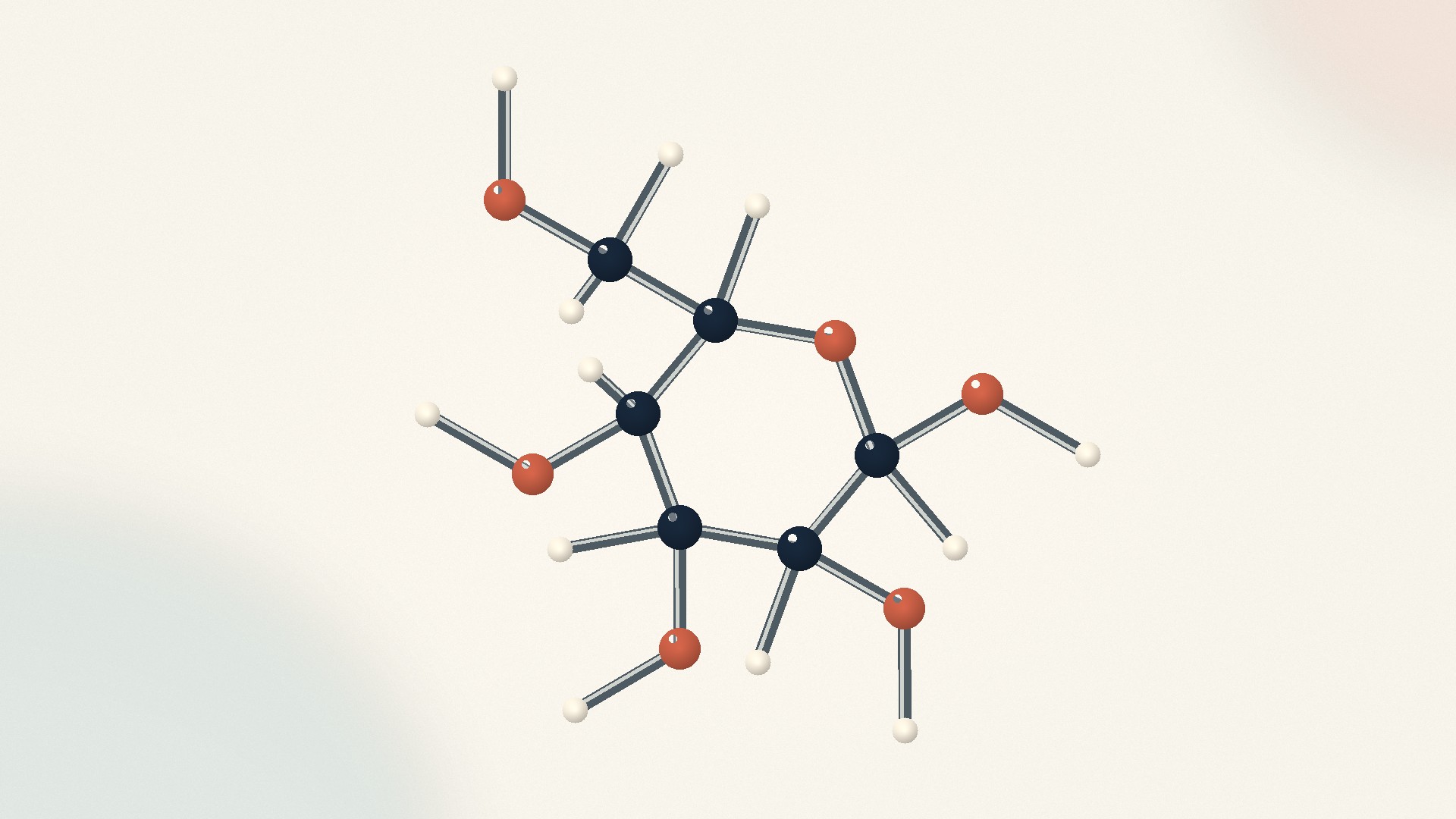
Sugars
One Sugar Is Not Every Sugar — Why is a sugar more than a molecular formula?
A smaller part of the carbohydrate family
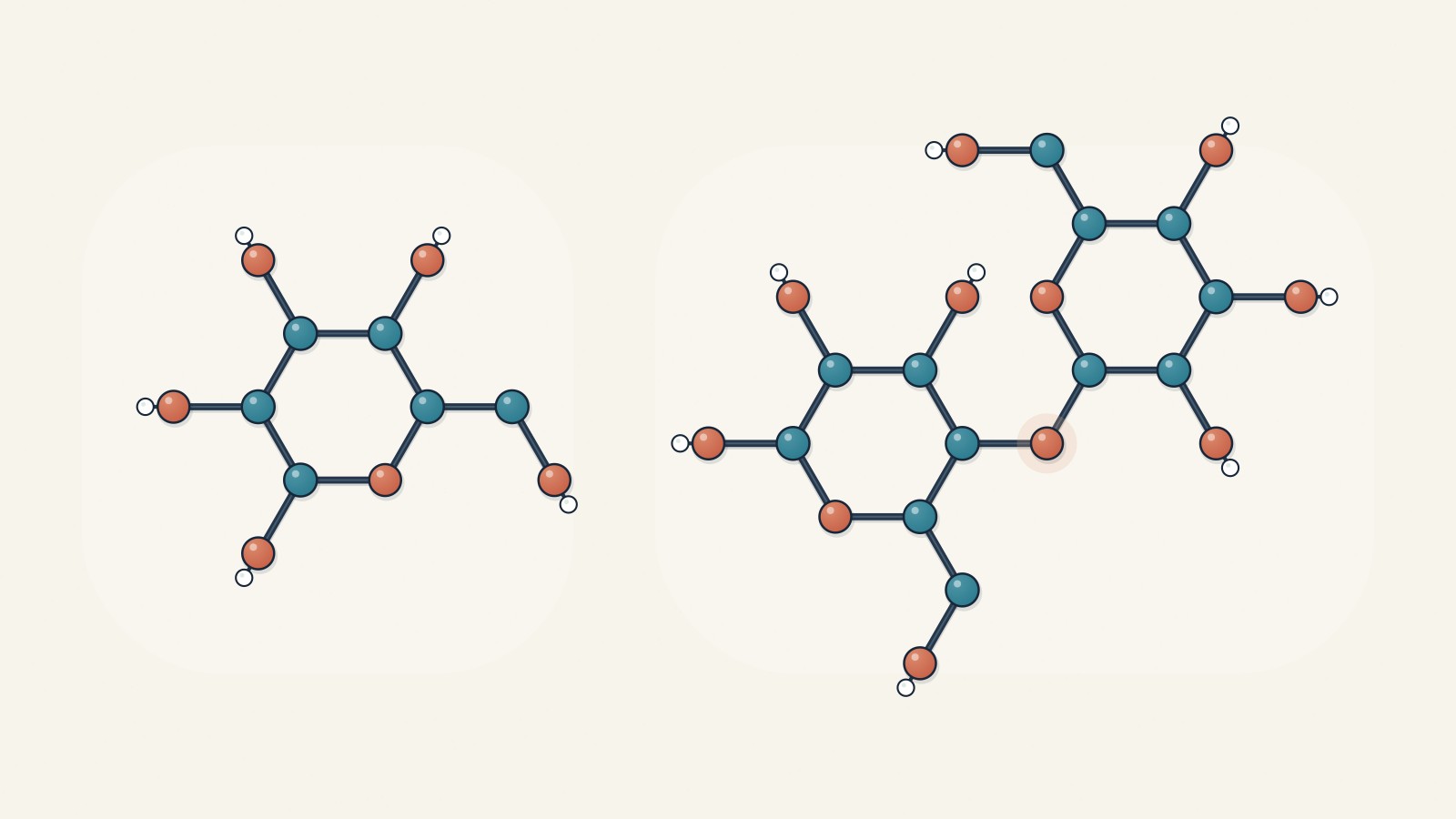
The preceding Page placed sugars within the wider carbohydrate family. Now we can ask a more precise question: how many sugar units make up a particular sugar? Glucose and fructose are MONOSACCHARIDES: each is one sugar unit.
Other sugars are made when two smaller sugar units join chemically. Sucrose, familiar as ordinary table sugar, is a DISACCHARIDE. It contains linked glucose and fructose units. The words are a useful classification, not a request to learn every sugar molecule.
Starch remains a larger carbohydrate made from many linked units. That earlier classification is our starting point, not another task to repeat here.
Who belongs where?
Imagine a researcher opening two trays: one holds substances made of a single sugar unit; the other holds sugars made by joining two units.
Glucose and fructose belong in the first tray. Sucrose belongs in the second. But knowing only that a substance has two linked sugar units would not identify it as sucrose: the exact units and how they are connected also matter.
The names help classify substances. They do not yet tell us which one a living cell is using, how its atoms are arranged or which reactions it can undergo.
Classify the specimen labels
Four labels are supplied: A glucose; B fructose; C sucrose; D an unidentified sugar described only as two linked sugar units. Classify each as MONOSACCHARIDE or DISACCHARIDE, state the number of units in each, then answer: Is D necessarily sucrose? What further information would establish its chemical identity?
Attempt on paper before opening Check your answers.
Check your answers
A and B are monosaccharides, one unit each; C is sucrose, a disaccharide containing two linked units; D is also a disaccharide, but its identity is not established. Two-unit classification alone cannot identify its component sugars, their connections or the specific compound.
The formula has a limit
You already know how to read the formula C₆H₁₂O₆: one represented molecule contains six carbon atoms, twelve hydrogen atoms and six oxygen atoms. That is useful information about composition.
But glucose and fructose BOTH have the molecular formula C₆H₁₂O₆. They are different substances because those atoms are arranged and connected differently. Two molecules can contain exactly the same number of each kind of atom without having identical chemical structures or properties.
That is the difference between reading a molecular formula and identifying a specific molecule. We will now follow one particular arrangement — glucose — not every possible molecule with that atom count.
What does the evidence establish?
Molecule X is labelled glucose and has the formula C₆H₁₂O₆. Molecule Y is labelled fructose and has the same formula. Decide which claims are SUPPORTED or NOT ESTABLISHED by these facts, explaining each.
1. Both molecules have six carbon atoms, twelve hydrogen atoms and six oxygen atoms. 2. The molecules must be chemically identical because their formulas match. 3. The labels tell us the identities of two different sugars. 4. Knowing only the shared formula proves exactly how a cell uses either sugar. 5. A different arrangement of the same atoms can produce a different substance.
Check your answers
(1) Supported; subscripts define composition. (2) Not established/false; glucose and fructose are distinct molecular structures. (3) Supported: they are two named simple sugars. (4) Not established: formula doesn't determine biological use. (5) Supported: arrangement matters for identity and properties.
Remember the path
1. What distinguishes a monosaccharide from a disaccharide? 2. Give two named single-unit sugars and one named double-unit sugar. 3. Why does knowing that an unnamed sugar has two units not establish that it is sucrose? 4. What does C₆H₁₂O₆ tell you, and why can it describe both glucose and fructose? 5. What new question about glucose will the next Page answer?
Check your answers
(1) A monosaccharide is one sugar unit; a disaccharide has two chemically linked units. (2) Glucose and fructose; sucrose. (3) Unit count is a classification, not a unique chemical structure. (4) It gives six carbon, twelve hydrogen and six oxygen atoms in one molecule, not a unique arrangement; glucose and fructose differ in structure. (5) What this particular named substance does when living cells use or transform it.
A named sugar, at last
We now have the family, the subgroup and the need to identify a particular substance. Next is GLUCOSE. Its formula will be familiar; what makes it useful is not merely that we can count its atoms but that cells recognise and transform the particular molecule.