Population III Stars
How could a universe without stars produce its first stellar light?
Explore how gravity helped the universe form its first stars after Recombination, what we know about their composition, and what remains uncertain. The new private lesson develops the full investigation with learner-operated checks.
After the fog cleared
After Recombination, electrons could remain bound to nuclei, forming neutral atoms. Light travelled freely through the thinning gas. Some of that ancient radiation still reaches us as the **cosmic microwave background**.
Across the universe, vast clouds of mostly hydrogen and helium stretched through the darkness. The first stars were still to come.
I stayed with the matter as the ancient light travelled on.
The universe had become transparent, but it had not yet learned to shine for itself.
That would take another change.
Gravity gathers the gas
The gas had small differences in density. Gravity drew material into the denser regions. As more gas gathered, the growing clouds contracted and their centres became hotter.
Some clouds continued collapsing until their cores reached the conditions for a new kind of change.
The first stars shine
Deep inside those hot, dense cores, **nuclear fusion** began. Reactions involving atomic nuclei released energy, heating the gas and helping to support the new stars against gravity.
Light spread from the first stars into the surrounding darkness. The first stars appeared in different regions as conditions allowed. Their exact beginnings remain difficult to reconstruct.
The darkness changed its meaning.
The first stars were shining from within, and I could follow that new light back to the matter making it.
The story had found a new source of change.
The first generation
These stars formed from hydrogen and helium, with tiny traces of lithium left by the early universe.
Astronomers call the first generation **Population III**. They describe its birth material as almost **metal-free**: in astronomy, *metals* means elements heavier than helium, including carbon and oxygen.
Were all the first stars enormous?
We think many of the earliest stars may have been very massive and extremely hot. Such stars can produce powerful ultraviolet radiation.
But models of the first stellar generation do not give us an exact list of every star. Their masses, lifetimes and individual fates remain uncertain. We should not say that every first star was enormous, or that every one died in the same way.
Our evidence is strongest about the early universe’s overall ingredients and sequence of changes. Many details of the first individual stars remain research questions.
A second change to the gas
Remember Recombination: electrons became bound to nuclei, and neutral atoms could remain together.
Hot stars can produce energetic ultraviolet light. Some of that light can knock electrons away from hydrogen atoms again, leaving charged hydrogen ions.
This later process is called reionisation.
The words sound similar, but the events are not the same:
Recombination: free electrons become bound; neutral atoms become widespread.
Reionisation: energetic radiation removes electrons from many neutral hydrogen atoms.
The first hot stars probably helped start this later process. The exact contribution of the earliest stars, compared with later stars and galaxies, is still studied.
Traces of the first stars
The cosmic microwave background records tiny variations in the early distribution of matter. Physics and computer models show how gravity could turn those variations into denser clouds and eventually stars. Light from distant galaxies shows that stars existed while the universe was still young.
Some ancient stars also contain small quantities of heavier elements, evidence that earlier generations had already produced and released them. Together, these traces allow scientists to reconstruct the rise of the first stars. Individual Population III stars have yet to be confirmed, and their precise masses and fates remain uncertain.
What could stars make?
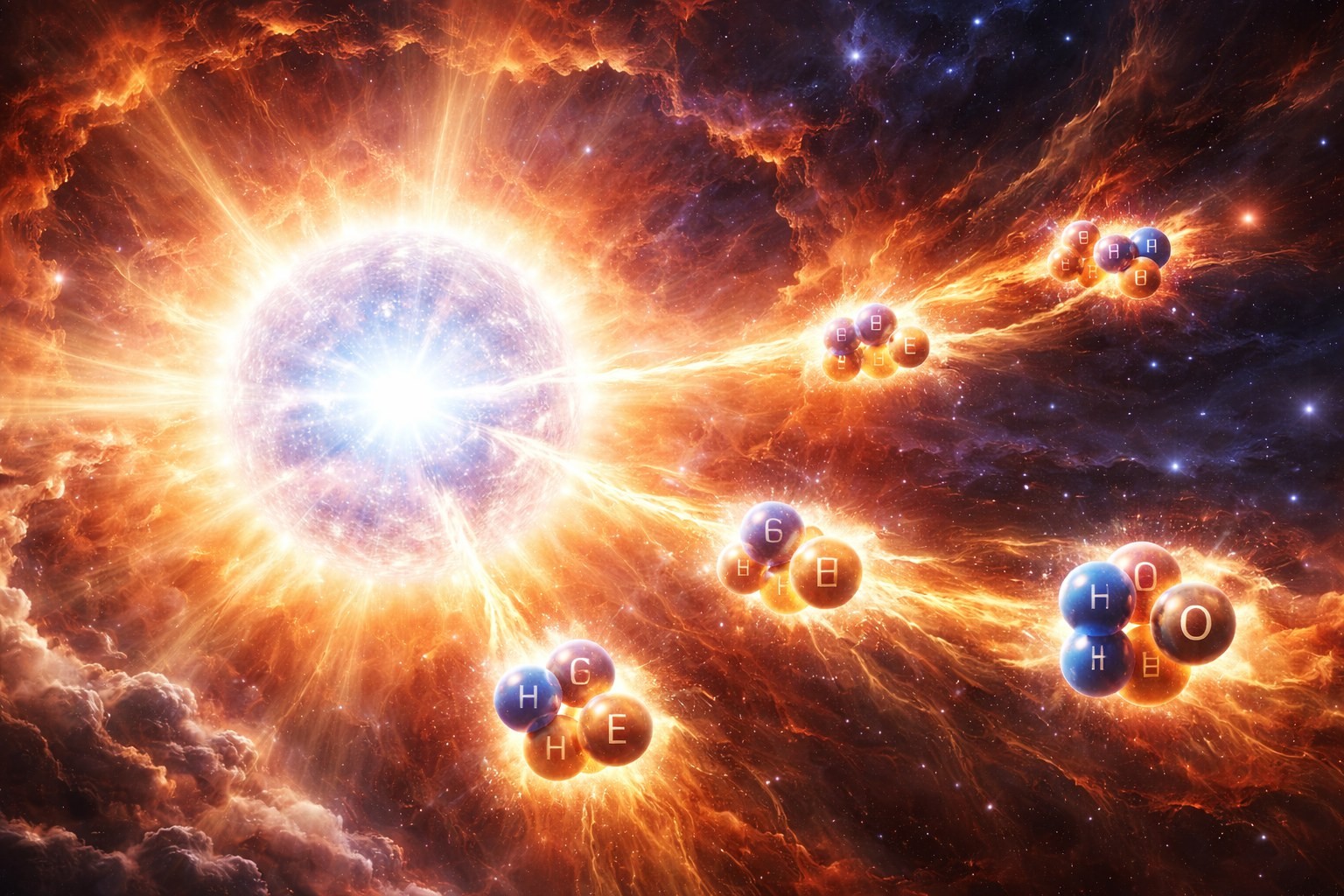
As the first stars shone, nuclear reactions inside some of them began producing new kinds of nuclei. Carbon and oxygen would become essential ingredients in the chemistry that followed.
How could a star produce those elements from the hydrogen and helium with which it began?
Deeper page
Population III Stellar Fusion
Continue into Population III Stellar Fusion to investigate how light nuclei change and why the reactions release energy.
New elements spread
Some stars released material into surrounding space through stellar winds or explosive events. That material carried elements made inside stars into clouds of gas. The material left behind could form a dense stellar remnant.
Later stars could form from clouds containing a richer mixture of elements. Carbon, oxygen and other atoms could then take part in a wider range of chemical combinations.
I followed some of what the stars released into the space between them.
Later clouds could gather that material, and their chemistry could begin with more possibilities.
Your story was widening.