Population III Stellar Fusion
How did the earliest stars make energy and begin forming new nuclei?
Discover why positively charged nuclei normally repel, how stellar cores can sustain nuclear fusion, why mass differences correspond to released energy, and how some stars begin making carbon and oxygen. The full interactive learning sequence is being prepared privately.
The star has changed the problem
Before the first stars, most ordinary matter in the universe consisted of hydrogen and helium, with tiny traces of lithium.
Then gravity gathered some of that gas into dense, hot regions. Some became the first shining stars.
So what was happening inside them?
You already know the difference between a nucleus and a complete atom. A nucleus contains protons and, usually, neutrons. Electrons belong to the atom around the nucleus.
In the extremely hot gas inside a star, electrons are not generally attached to nuclei as complete neutral atoms. The stellar core is plasma: nuclei and free electrons moving through very hot matter.
The change that powers a star is a nuclear one. It does not begin with two whole atoms sticking together like a chemical molecule.
Why nuclei do not easily meet
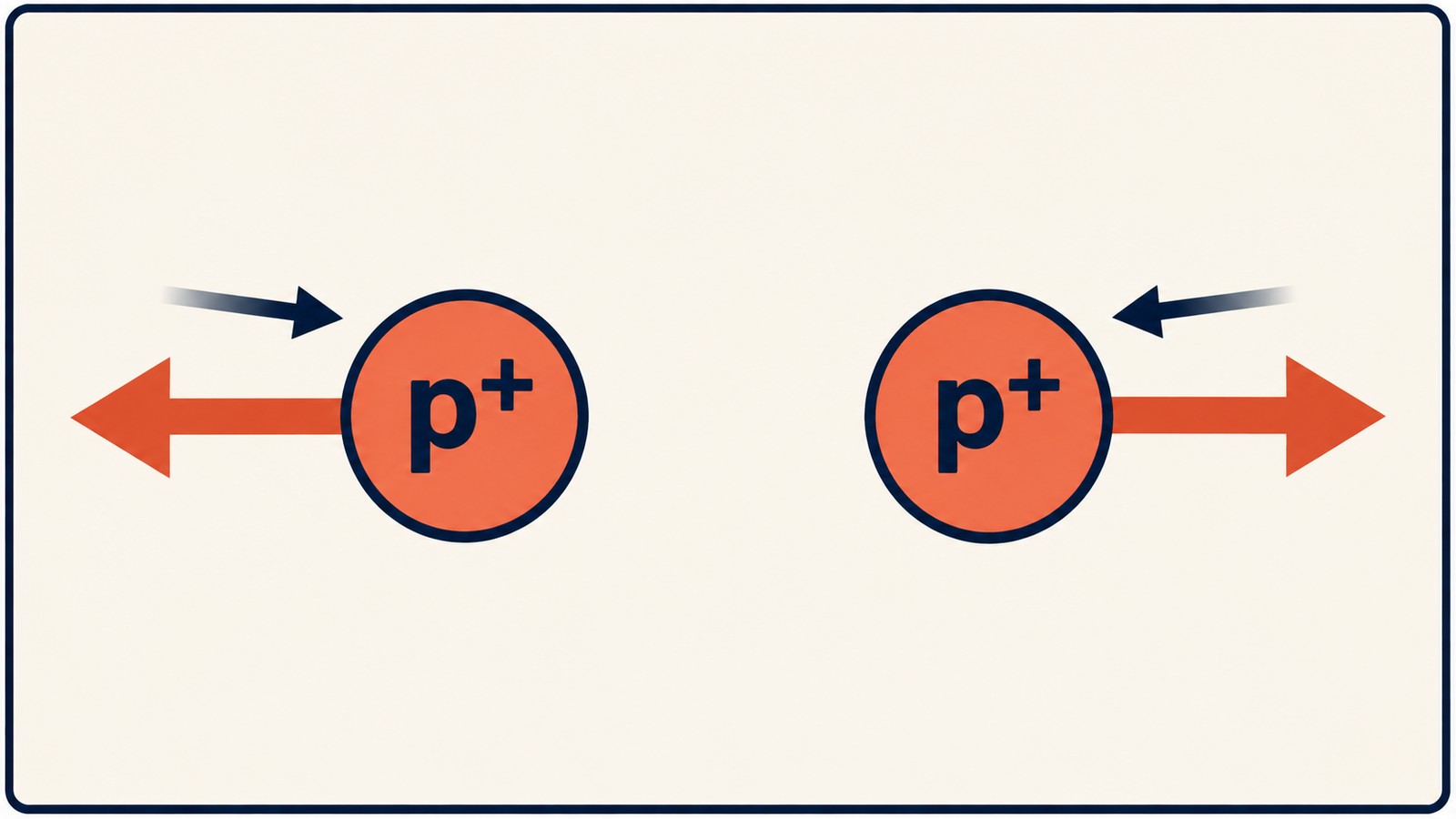
Every proton has positive electric charge.
Two positive charges repel one another. So two hydrogen nuclei, each containing one proton, repel as they approach.
That creates a difficulty. If they cannot get sufficiently close, they cannot undergo fusion.
The force keeping them apart is electrostatic repulsion. A cool, thin cloud may contain countless hydrogen nuclei, yet it does not sustain fusion.
When the conditions change
Inside a star, gravitational compression produces extremely high pressure and temperature.
Higher temperature means nuclei are moving with more energy. High density and pressure mean a very large number of nuclei occupy a small space, so encounters are much more frequent.
At suitable stellar-core conditions, some positive nuclei can get close enough for nuclear reactions to occur. They do not all overcome repulsion at once; fusion is a sequence of individual, probabilistic events.
The detailed explanation involves quantum physics, but you do not need that theory for this lesson. The essential GCSE explanation is that electrostatic repulsion prevents sustained fusion at low temperatures and pressures, while suitable stellar-core conditions make fusion possible.
The force that ultimately binds protons and neutrons inside a nucleus acts only at very short distances. Fusion requires nuclei to approach sufficiently closely for nuclear binding to take effect.
The obstacle
Draw two hydrogen nuclei as separate circles, each labelled +.
Answer on paper:
1. Draw an arrow on each nucleus to show which way the electrical force pushes it as the nuclei approach. Explain the directions using their charges.
2. Why does a cloud containing hydrogen not automatically undergo fusion?
3. State two conditions inside a star that make nuclear fusion more likely. For each condition, explain how it helps positively charged nuclei approach closely enough to react.
Select CHECK YOUR ANSWER after writing.
Check your answers
1. Each positive nucleus repels the other, pushing them apart.
2. Electrostatic repulsion keeps most nuclei from approaching closely enough for fusion in an ordinary cool cloud.
3. Higher temperature means greater kinetic energy; greater density/pressure makes encounters more frequent, so some nuclei can approach closely enough for fusion.
A complete answer must mention positive-charge repulsion, not just ‘it needs heat’.

Hydrogen does not simply become a bigger hydrogen atom
The most important early stellar fuel is hydrogen.
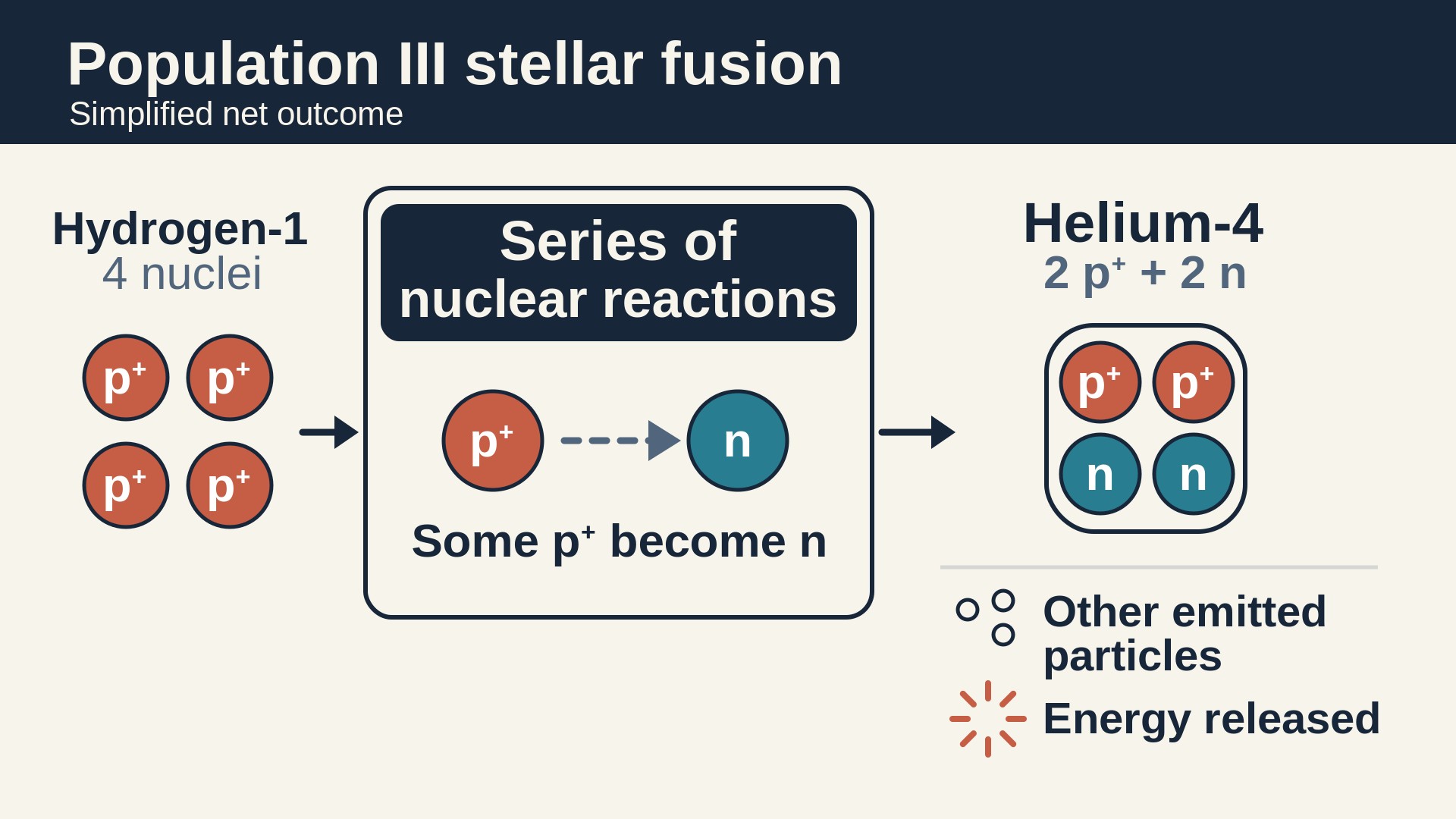
During stellar hydrogen burning, a series of nuclear reactions turns hydrogen nuclei into helium nuclei.
A simplified overall account is:
Four hydrogen-1 nuclei take part → one helium-4 nucleus is produced, along with other emitted particles and released energy.
That is a summary of several steps, not a claim that four protons snap together in a single reaction. Some protons change into neutrons during the process, and other particles carry away energy.
Helium-4 has two protons and two neutrons, just as you learned earlier. The new helium nucleus is larger than the starting hydrogen nuclei.
This is nuclear fusion: smaller nuclei take part in reactions producing larger nuclei.
By contrast, when two hydrogen atoms form an H₂ molecule, they share electrons without changing their nuclei. That is chemical bonding. Fusion changes the nuclei themselves.
Fusion in stellar cores is a source of the energy that keeps stars shining. Heat from these reactions also helps support stellar gas against gravity.
The missing mass
A strange thing happens when some light nuclei fuse.
The total rest mass of the resulting nuclei and other particles can be a little less than the total rest mass of the starting particles.
That difference in rest mass corresponds to energy released by the nuclear reaction. The mass has not simply vanished without a trace: the energy leaves in radiation and moving particles, and can heat the star.
This is why the energy of a star does not have to come from chemical burning in oxygen. Its lasting energy supply is nuclear.
You can see the idea using a simplified numerical model. These numbers are invented for this exercise, not measured masses of a particular stellar reaction:
Total rest mass before a fusion reaction: 10.00 model units.
Total rest mass of the reaction products: 9.93 model units.
The difference is 0.07 model mass units. The corresponding energy is released.
For this GCSE explanation, you do not need to calculate the released energy in joules. You need to explain what the mass difference means.
Account for the mass
A different model fusion reaction starts with particles whose total rest mass is 8.00 model units. The final products have a total rest mass of 7.95 model units.
1. Subtract the final rest mass from the initial rest mass. Show your calculation and give the answer in model mass units.
2. State whether energy is released or absorbed in the model. Justify your answer using the before-and-after rest masses.
3. Explain why saying “the missing mass was destroyed” is misleading.
4. Explain how this model connects to the energy of a shining star.
Check your answers
1. 8.00 − 7.95 = 0.05 model mass units.
2. Energy is released.
3. The decrease in rest mass corresponds to energy released in the products, rather than an unexplained disappearance.
4. Repeated nuclear fusion releases energy that heats a star and contributes to its light.
These are invented model numbers, not measured nuclear masses.
The first stars began making new nuclei
Hydrogen burning produces helium. But the story need not stop there.
In some stars, after their core hydrogen supply changes, the internal conditions become suitable for helium-burning processes. These can build carbon nuclei. In suitable later reactions, oxygen nuclei can also form.
Not all stars reach the same temperature, make the same quantities or follow the same history. Stellar mass and internal structure matter.
For the first stellar generation, this is extraordinary. The stars began with gas that contained almost no carbon or oxygen. Some could make those elements inside themselves.
Making an element inside a star is not the same as putting it into the space between stars.
A new nucleus can remain trapped
Picture two different stellar outcomes.
In one case, nuclear reactions produce carbon deep within a star, but much of that matter remains locked in the stellar remnant.
In another case, a star expels material into surrounding space. The gas between stars can become enriched with nuclei made inside an earlier star.
Some stars eject heavy elements through stellar winds or catastrophic events, including certain supernovae. Other stellar endings may retain much of the newly formed matter.
Do not assume that every Population III star exploded or that every star released every element it made. We are investigating processes and possible outcomes, not a perfectly observed list of the first individual stars.
The elements that do enter surrounding gas can later become part of new stars and eventually planets and living chemistry.
Nuclear change or chemical change?
You have encountered hydrogen before in two different ways.
When two neutral hydrogen atoms share electrons to make a hydrogen molecule, H₂, their nuclei remain hydrogen nuclei. That is chemical bonding.
When hydrogen nuclei participate in fusion reactions that produce helium nuclei, the nuclear structure changes and energy is released. That is nuclear fusion.
The distinction matters: changing the bonds between atoms is not the same as changing atomic nuclei.
Sort the changes
For each situation, label:
N — nuclear change;
C — chemical change;
E — dispersal of an already-created element.
1. Two hydrogen atoms share electrons and form one H₂ molecule.
2. Several light nuclei take part in reactions whose net result includes a larger helium nucleus.
3. A star makes carbon nuclei in its core, but they remain inside the final remnant.
4. A stellar event throws already-formed carbon into surrounding gas.
Explain why item 3 and item 4 describe two different stages of the cosmic story.
Check your answers
1 = C: electron sharing produces H₂ without changing nuclear identities.
2 = N: fusion reactions change nuclei and result in a larger helium nucleus.
3 = N: nuclear synthesis created carbon, but the carbon remains within the star
emnant.
4 = E: the already-created carbon is thrown into surrounding gas.
Making carbon is different from spreading it through space.
Carry the question forward
The first stars did two important things that were not possible during the earlier Dark Ages.
They supplied their own energy through nuclear reactions. Some also began producing new nuclei that could later be released to enrich the universe.
Carbon and oxygen, now possible, will matter when our history reaches chemistry and the conditions for life.
But first, keep the nuclear rules clear. They will appear again in GCSE Physics.
Remember this lesson
Try these without looking back. Write your answers before opening the check.
1. Define nuclear fusion in terms of the starting and resulting nuclei.
2. Explain why the positive charges of protons make fusion unlikely in a cold, low-pressure cloud.
3. Explain why a star’s extremely hot, dense core makes fusion more likely.
4. In a model reaction, the total rest mass before fusion is 7.00 units and afterwards is 6.96 units. Find the difference and explain its connection to the energy released.
5. State the energy source that makes stars shine, and explain why this is not simply chemical burning.
6. Explain the difference between (a) forming carbon inside a star and (b) releasing carbon into surrounding gas.
7. Compare a hydrogen molecule forming from two atoms with a nuclear fusion reaction that produces helium. Which part of matter is changed in each case?
Check your answers
1. Fusion is a nuclear process producing larger nuclei from lighter nuclei.
2. Positively charged nuclei repel, so at low temperature and pressure they rarely get close enough for fusion.
3. Higher temperatures raise kinetic energies and high density/pressure raises encounter rates; some nuclei can get close enough to fuse.
4. 7.00 − 6.96 = 0.04 units of rest-mass decrease, corresponding to released energy.
5. Nuclear fusion powers stars, not chemical burning in oxygen.
6. Carbon creation is nuclear synthesis inside the star; carbon release is movement into surrounding gas.
7. H₂ formation shares electrons without changing nuclei; fusion changes nuclei and may produce helium.